
Home     Fort George & National Historic Sites     Brock's Monument     Ghost Tours     Upcoming Events  
  Gift Shop     Fife and Drum Corps     Summer Employment     Membership     Links     Contact Us  


Fort George
Located on the
Niagara Parkway,
Niagara-on-the-Lake

Open weekends in April,
daily May to October,
10:00 a.m. - 5:00 p.m.

Admission fee.

Tours of the site are offered every hour on the hour and include a visit to all of the buildings and a musket firing demonstration.
The last daily tour begins
at 4 p.m.

See Upcoming Events page for events listing.

Guided tours year round by appointment.
School tours and overnight programs are offered by
Parks Canada.
To reserve call
905-468-6614


A Brief History of The Fort
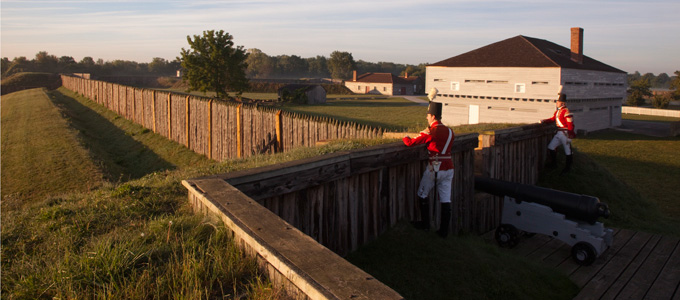
  From 1812 to 1814, Niagara was a hotly contested battleground, invaded by armies of the United States. Through that bitter conflict, Fort George played a vital role.
  No visit to the town is complete without a tour of the venerable Fort George National Historic Site of Canada, where British soldiers, Canadian militiamen and Aboriginal peoples fought to ensure that Ontario was not annexed to the United States.
  Fort George has been restored to the War of 1812 period and contains buildings furnished to recreate the site as it would have been during war.

Visitors can tour the Soldiers Barracks, where the wives and children of the soldiers shared the same living space as the men or the Officer’s Quarters where upper class


English officers lived a much more elegant lifestyle. The stone Powder Magazine where gunpowder was stored, remains as the oldest building in Niagara-on-the-Lake, surviving bombardment from Fort Niagara and a U.S. Navy fleet. Other buildings, the Blockhouses, Guard House, Kitchen and Artificers (craftsmen) Shop, help tell the story of this nationally significant site.
  In July and August, the period guard demonstrates the drill and tactics of 1812 with musket and cannon fire while the Fife and Drum Corps perform the thrilling music that resounded on the battlefields of that time.
  The Fort is in the old town of Niagara-on-the-Lake and is about a 25 minute drive north of Niagara Falls, one of Canada's foremost attractions.

Images of Fort George courtesy of Parks Canada. Brian Morin, photographer.


Butler's Barrack on the Commons
Lincoln and Welland Regiment Museum

Corner of King and John Street, set far back from the road. Parking available in lot off of John Street.

Operates seasonally as funding allows.
Small admission fee.
Free for military members and veterans.

For current operating schedules:
tel: 905-468-0888
email:
lwmuseum@beacon.org
website:
www.lwmuseum.ca


Butler's Barracks
  Five original buildings from 150 years of military operations remain. Enjoy a leisurely stroll along the landscaped grounds. Located in historic Butler's Barracks on the Commons, the Lincoln and Welland Regiment Museum is nestled in the former Camp Niagara training grounds. The Lincoln and Welland Regiment traces its roots back to the Butler's Rangers, and continues to play a major role in world events to this day through its peacekeeping missions, displaying the evolution of one of Canada's oldest regiments from Butler's Rangers, War of 1812-14, Fenian Raids, World War I, World War II, through to modern day operations.

Fort Mississauga
  In the year 2000, The Friends of Fort George constructed a trail for easier access to Fort Mississauga, located today on the Niagara-on-the-Lake Golf Course. Burned by the retreating Americans in 1813, the brick tower was reclaimed from the ruins of the town of Niagara. Over the succeeding decades, Fort Mississauga was garrisoned on a limited and sporadic basis. Abandoned in the 1860s, it was home to the Canadian militia in 1872 and to training camps in both World Wars.


Navy Hall
  In 1765, British naval craftsmen from Fort Niagara erected a barracks on the opposite side of the Niagara River. Over the years several buildings, known collectively as Navy Hall, evolved into a large military complex and became a key supply depot for British forts on the upper Great Lakes. During the American Revolution, the Provincial Marine wintered at Navy Hall and, in 1792, Lieutenant-Governor John Graves Simcoe converted one of the buildings into his residence. Navy Hall was destroyed by American forces during the War of 1812. After the war, the British reconstructed some of the buildings, of which one still survives. Navy Hall, located on the Niagara River, provides a unique and picturesque location for special events and dinners. Call the Parks Canada office at 905-468-6609 for private rental information.

Navy Hall

Fort Mississauga

Images courtesy of Margaret Dunn:
Butler's Barracks, Fort Mississauga & Navy Hall